Bedford Rowing Club has been rowing in Bedford since 1886. The Ergonauts is where most people start their journey — an indoor rowing programme for adults who have never rowed, run by club coaches on the machines rather than on the water.
You do not need to be fit, and you do not need to have played a sport since school. Everyone on the course is starting from the same place, and nobody is expected to know what they are doing. The coaches will set you up on the machine and take you through the stroke.
Thirteen weeks from now you will row a measured 2,000m and set it against the one you rowed in Week 3. If you want to carry on after that, the next step is Learn to Row, on the water.
Please read. Always consult your doctor before starting any exercise programme to determine whether it is right for you. This programme is not a substitute for professional medical advice, diagnosis or treatment, and its use is at your own risk. Bedford Rowing Club shall not be liable for any damages or injuries, however caused, arising during or after use of these training programmes or recommendations.
Every session
Meet at 10am in the Clubhouse barWe start with stretching in the gym, then a recap of the week before, before anyone gets on a machine.
Water breaks between blocksEach session is built from blocks with a break between them. Take them.
Ask for technique helpThe basics are quick to learn and improve steadily. Club coaches are there to get you started — do use them, particularly in the first fortnight.
Record every row
Set up the free Concept2 Logbook before your first session. It keeps every row you do in one place — including your Week 3 and Week 13 2,000m — so you can see your progress, and share a session with a coach for feedback.
2 Download the ErgData appFree on iPhone and Android — search “ErgData” in the App Store or Google Play, and sign in with your Logbook account.
3 Connect before you rowOpen ErgData, connect to the monitor on your machine, then row. When you finish, the session saves to your Logbook automatically.
4 Share itSend a coach the link to any session from ErgData or your Logbook, and it can be added to your page in Technique notes.
What follows explains the machine, the stroke and the numbers on the monitor. The thirteen sessions themselves are at the bottom — and once you have read this far, you can jump straight to your week from the bar at the top of the screen.
The equipment
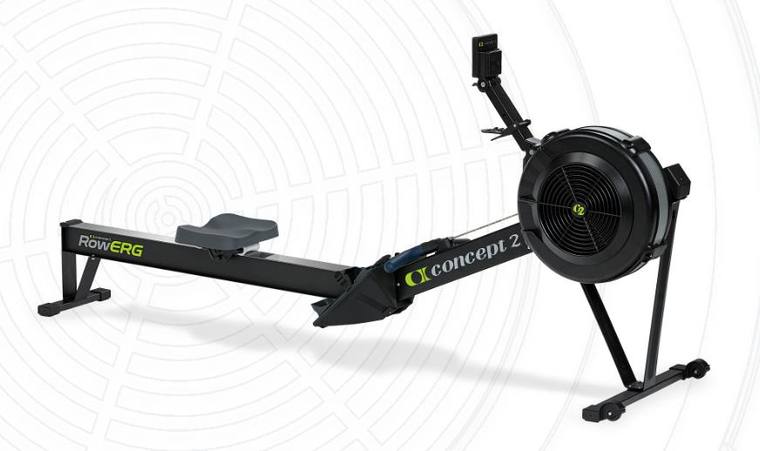
The Concept2 ergo
Setting yourself up
The monitorAt eye level, so you are not craning down at it while you row.
The foot strapsAcross the ball of your foot, tight enough that your heels can lift a little at the catch but your feet do not move.
The damperThe lever on the side of the flywheel. Set it at four or below. A high damper feels impressive and teaches bad habits — it is not a difficulty setting. What it actually changes is drag factor, which the monitor can show you.
Using the monitor
For most sessions you need do nothing at all — pull the handle and the monitor wakes up and starts counting. Concept2 call this a Just Row, and anything over a minute is saved automatically.
When a session asks for a set distance — the 2,000m in Weeks 3 and 13, or the 1,000m pieces in Weeks 9 and 11 — set it up first, so the monitor counts down to zero and gives you a finishing time. From the main menu: Select Workout → New Workout → Single Distance, then enter the distance.
Concept2's own guide covers the rest: the different display screens, splits, drag factor and how to find past workouts in the memory.
Designed by rowers, the Concept2 simulates the motion of rowing on water. It is the standard machine for indoor rowing competition and is used equally by professional crews and by people who simply want to keep fit.
Measurement. Distance, time, strokes and power output, from a workout that uses legs, core and upper body.
Resistance. A flywheel and damper system, adjustable to mimic different rowing conditions.
Monitor. The PM5 tracks pace, calories and stroke rate.
Why it suits beginners. Low impact, high calorie burn, and good for cardiovascular health and endurance.
Technique
The rowing stroke
One continuous movement in four parts. The order is what matters: legs, body, arms as you drive back, then arms, body, legs as you come forward again. Count two on the drive and three on the recovery — a firm push, a slower return.
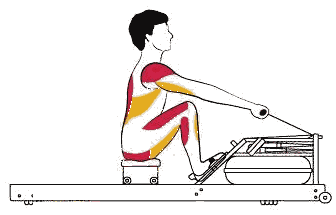
The beginning of the stroke. Sit tall with your arms straight, back upright, and knees and ankles flexed so your shins are roughly vertical. Relax the spine, use your lats to pull your shoulders down, and brace your core — this protects your lower back. Then lean forward slightly, keeping your back tall.
Back straight
Body forward
Legs compressed
Arms extended
2
The Drive
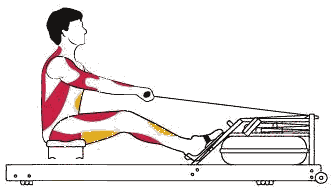
Begin by pushing with your legs while still bracing your core. When your legs are straight, hinge at the hips and lean back to about 45 degrees. The last movement is from your arms, drawing the handle to your torso a few inches above the navel. The order matters: legs, core, hips and shoulders, arms.
Push with legs
Hips and shoulders
Arms last
3
The Finish
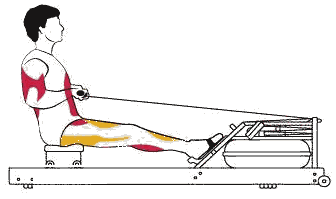
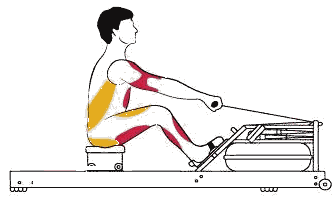
Sometimes called the release — the resting position opposite the catch, though you will not rest here for long. Legs are long, shoulders and back lean away from the legs, the handle is drawn in toward the body and the elbows are tucked past the torso.
Legs straight
Shoulder blades squeezed
Handle to the chest
4
The Recovery
Now reverse the drive to return to the catch. Extend the arms, hinge the hips forward to bring the torso over the legs, then bend the knees and let the seat run forward under control.
Arms extended
Handle past the knees
Control the slide
Power and breathing
Where the power comes from
The common misconception is that rowing is all about the arms. Row with your arms alone and you risk hurting your arms and shoulders. Rowing uses 86 per cent of your muscles — roughly 65 to 75 per cent legs, 25 to 35 per cent upper body.
60% legs
20% core
20% arms
Legs. Push against the footplates to build the power.Core. Braced, it transfers that power to your upper body.Arms. Last, and least.
Ratio: one to two
Most novices drive slowly and rush the recovery. It should be the other way round — a sharp drive, a relaxed recovery, roughly one second driving for every two recovering. Taking your time on the recovery sets up a strong position at the catch and a smooth transition back into the drive. This is what the sessions mean by ratio rowing, and by Week 7 it should feel automatic rather than something you think about.
Drive
Recovery
Breathing
Tie your breathing to your stroke and keep the pattern steady — that is what keeps oxygen going to the muscles as the work gets harder. At light pressure most rowers take one breath per stroke: exhale gradually through the drive, empty the lungs at the finish, breathe in on the recovery. Rowing hard, add a second, shorter breath — exhale as you finish the drive, inhale then exhale quickly on the recovery, and take one more breath just before the catch. Where exactly you switch from one breath to two is personal; experiment until you find your own rhythm.
Individual feedback
Technique notes
Personal pointers from video of each rower. Tap your name. To check your own figures against a session at any time, use the Session report.
From a short video filmed during a session, about four strokes at around rate 20. Overall a solid stroke: the sequence is right and the set-up at the front is good. The main thing to work on is rhythm.
Doing well
A strong catchShins come up to vertical, arms straight, and a slight forward lean from the hips without hunching.
The right order on the driveLegs push first with the arms still straight, then the body swings back, then the arms draw in — exactly the sequence the course teaches.
A tidy finishHandle to the lower ribs, forearms level, head still, and a lean back that stays within the 45° the Drive section describes.
To work on
1
Quicken the drive, slow the recovery
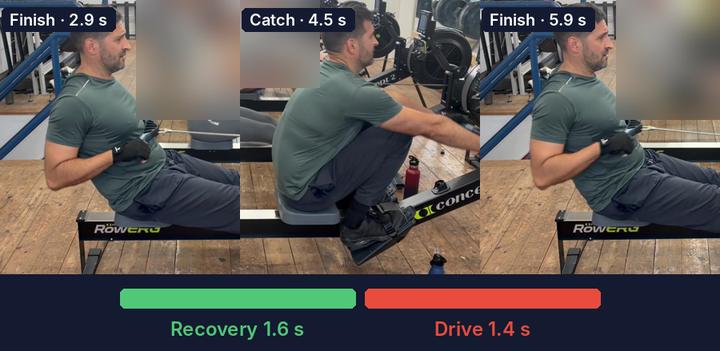
The drive takes about 1.4 seconds and the recovery about 1.6 — close to 1:1 rather than the 1:2 the programme asks for. The drive is a little slow for the rate.
One stroke, frame by frame: recovery and drive take almost the same time.
You arrive at full compression and stay there for about 0.4 seconds before the drive starts. The flywheel slows while you wait. The slow part of the recovery should be the slide, with the change of direction at the front immediate.
Cue“Arrive and go.”
Work on itRatio rowing — a slow, controlled slide, then straight into the push the moment your shins reach vertical.
3
Keep the legs down until the hands pass the knees
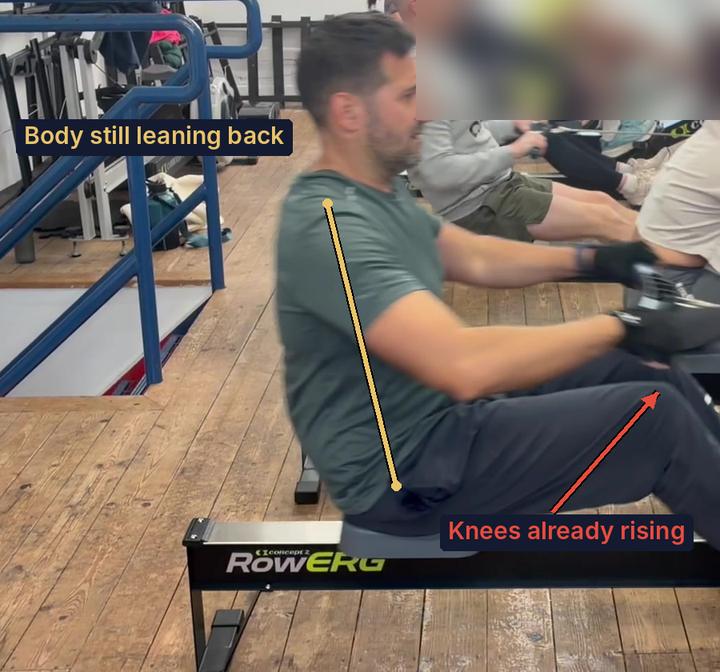
On the recovery the knees start to rise while the hands are only just reaching them and the body is still leaning back. That pushes the handle up and over the knees and leaves the body to swing forward late.
At 3.5 seconds: hands only at the knees, body still back, knees already bending.
Work on itPause drill — a 2-second pause at “arms away”.
4
Relax the shoulders at the finish
The shoulders creep up towards the ears as the handle is drawn in.
Cue“Shoulders down, elbows past the body.”
Work on itThink of drawing the elbows back rather than pulling the handle up.
5
Smooth acceleration on the drive
Not a fault yet, but one to hold on to as the rate rises in Weeks 11–13: the drive should get faster and harder from start to finish, not snatched in the first few inches.
Cue“Build the stroke, don’t hit it.”
Work on itLow-rate power strokes at rate 18 in the Week 9 mid-week session.
Based on a 12-second clip filmed side-on at a slight angle. Times are measured frame by frame from the video.
Checking for Concept2 sessions…
Monday 2 November 2026 · on your own
Steady row · 15 minutes
15 minutes continuous, splits every 3 minutes
Purpose. Treated as a steady row, like the mid-week session: rate 20, 5–6 out of 10, and the same split from start to finish.
Metres
Split /500m
Watts
Rate
0–3 min
587
2:33.3
97
18
3–6 min
629
2:23.0
119
19
6–9 min
648
2:18.8
131
20
9–12 min
646
2:19.3
129
19
12–15 min
620
2:25.1
114
18
Total
3,130
2:23.7
118
18
Heart rate
140 avg
Calories
179
Did it meet the purpose?
Right effort, uneven pace — a slow start, a strong middle, an easing finish
The effort was right for a steady row: rate 18–20 and heart rate 129–147 bpm, well below the 175 average in Tuesday’s 4 × 4 minutes.
The pace was not even: 2:33.3 for the first 3 minutes, 2:18.8 and 2:19.3 in the middle, then 2:25.1 to finish — about 14 seconds per 500m between the slowest and fastest splits.
The middle six minutes were the best part: 2:18–2:19 at rate 19–20 is a lot of speed for a low rate, which shows a long, well-connected stroke.
The first split looks like a warm-up. If it was, the 12 minutes after it averaged about 2:21.6.
Next timeNext time, warm up separately, then settle at about 2:21 from the first stroke and hold it at rate 20 to the end. The target: every split within 2 seconds of the others.
Tuesday 3 November 2026 · before the 4 × 4 minutes
Warm-up · 8 minutes
8 minutes continuous, splits every 2 minutes
Purpose. Build gently, as the programme’s warm-ups ask: light at rate 18 to start, then half pressure at rate 20, lengthening out.
Metres
Split /500m
Watts
Rate
0–2 min
388
2:34.6
95
19
2–4 min
400
2:30.0
104
19
4–6 min
420
2:22.8
120
20
6–8 min
427
2:20.5
126
21
Total
1,634
2:26.8
110
19
Heart rate
130 avg
Calories
91
Did it meet the purpose?
Yes — a well-built warm-up
Every split was quicker than the one before: 2:34.6, 2:30.0, 2:22.8, 2:20.5. That steady build is exactly what a warm-up should do.
The rate stayed low, 19–21, so the extra speed came from pressure, not from rushing the slide.
Heart rate rose gently from 118 to 143 bpm — warmed up, but nowhere near working hard.
The last two minutes (2:20.5) were already a touch quicker than Monday’s whole steady row. That is fine before firm work, but no faster than this.
Next timeKeep this pattern. If anything, start at rate 18 for the first four minutes, as the programme suggests, and keep the last block at about 2:22.
Tuesday 3 November 2026 · Sunday’s session, done mid-week
Week 6 · Main aerobic piece
4 × 4 minutes, light paddle between
Purpose. Hold the same split on every rep, at rate 20–22 and 6–7 out of 10. This is pacing practice for the retest.
Metres
Split /500m
Watts
Rate
Rep 1
946
2:06.8
171
23
Rep 2
949
2:06.4
173
24
Rep 3
954
2:05.7
176
25
Rep 4
1,001
1:59.8
203
26
Total
3,851
2:04.6
181
24
Heart rate
175 avg
Last rep
185 bpm
Rest metres
922 m
Did it meet the purpose?
Not quite — three very even reps, then a race on the last
Reps 1–3 were superb pacing: 2:06.8, 2:06.4 and 2:05.7, all within 1.1 seconds. That is exactly what this session is after.
Rep 4 jumped to 1:59.8 and 203 watts — about 6.5 seconds per 500m quicker than the others, and nearly 20% more power. That turns a pacing piece into a race finish.
The rate crept up on every rep, 23, 24, 25, 26, all above the 20–22 target. The extra speed came partly from rating higher rather than from pressure alone.
Heart rate rose from 166 to 185 bpm over the four reps — the last rep was clearly well above 6–7 out of 10.
Next timeNext time, lock the rate at 22 and aim for about 2:06 on every rep — you showed in reps 1–3 that you can do it. If you have something left at the end, finish within a second of the others, not six.
My course
How Jose has developed
Week 32,000m baseline
Week 6First video (provisional)
Week 8Technique baseline video
Week 10Mid-course video
Week 13Final video and 2,000m test
2,000m
Week 3—
→
Week 13—
Week 3 time to be added. The Week 13 test completes this.
Fitness — the key sessions
Going faster, or making more watts, at the same rate is the clearest sign of getting fitter. More metres per stroke at the same rate shows a more effective stroke.
Session
Type
Split
Watts
Rate
m/stroke
Steady row · 15 min continuous
Steady
2:23.7
118
18
—
Wk 6 · 4 × 4 min
Firm
2:04.6
181
24
—
A trend chart appears once there is a second steady session at rate 20–22 to compare against — next is Week 8’s 2 × 12 minutes.
Technique scorecard
Week 6
Week 8
Week 10
Week 13
Stroke order: legs, body, arms
Secure
·
·
·
Body over before the slide
Getting there
·
·
·
Tall back at the catch
Secure
·
·
·
Lean back at the finish
Secure
·
·
·
Hands, elbows and head at the finish
Getting there
·
·
·
Rhythm: quick drive, slow slide
Working on it
·
·
·
Key: SecureGetting thereWorking on it · = to come. Week 6 scores are provisional, taken from a short clip filmed at an angle. The Week 8, 10 and 13 clips are filmed the same way each time — side-on, rate 20 — so they can be compared fairly.
Coach’s comment
To be added at the end of the course.
From a short video filmed during a session, about three strokes at around rate 22. A calm, controlled stroke with a good rhythm — the drive is quicker than the recovery, which is exactly what the programme asks for. The main thing to work on is body position at the front of the stroke.
Doing well
The ratio is rightAbout 1 second on the drive and 1.7 on the recovery — close to the 1:2 the programme is after, and better than most at this stage.
Arms straight through the leg driveThe arms stay long until the legs are nearly flat, so the power from the legs reaches the handle.
A controlled finishA modest lean back, well within the 45° the Drive section describes, and an easy position to come forward from.
To work on
1
Swing the body forward before the knees bend
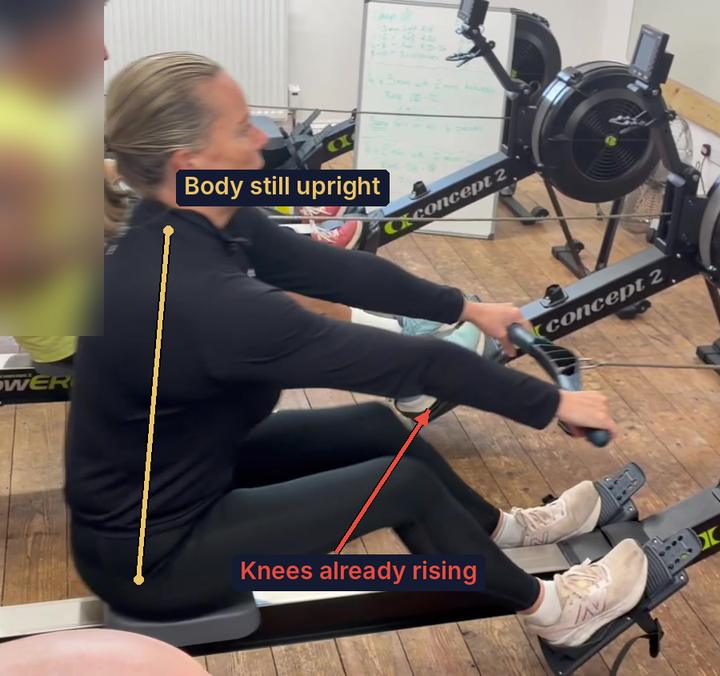
On the recovery the body stays upright until the knees start to rise, so the forward lean has to come late, from rounding the shoulders at the catch rather than from the hips.
At 4.3 seconds: arms already long and knees rising, but the body has not yet swung forward.
Cue“Arms, body, then slide.”
Work on itPause drill, pausing at “body over” — arms long, body angled forward from the hips — before letting the seat move.
2
Sit tall at the catch
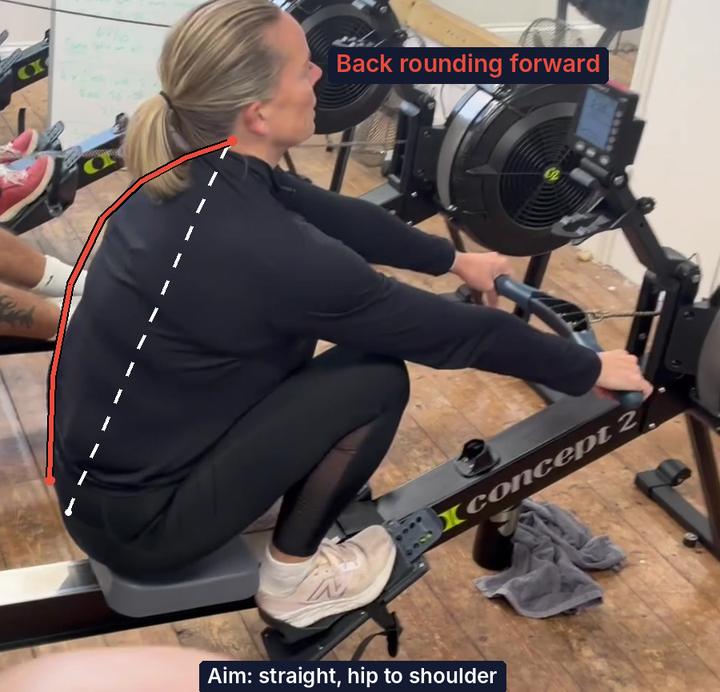
At the front the back rounds and the shoulders lift and reach forward. A tall, braced back is stronger and protects the lower back, especially as the pressure goes up.
At the catch: the red line follows the back; the dashed line is the straight back to aim for.
Cue“Chest up, shoulders down, reach from the hips.”
Work on itSlide build — arms only, then body and arms, then half slide, then full slide — keeping the back tall at every stage.
3
Keep that ratio as the rate goes up
Not a fault: the rhythm is already good at rate 22. The test is holding it at 24–26 in Weeks 11–13, where most people start rushing the slide.
Cue“Quick legs, slow slide.”
Work on itRate ladder in the Week 7 mid-week session — same feel at every rate.
Based on a 10-second clip, filmed handheld at a slight angle. Times are measured frame by frame from the video.
Checking for Concept2 sessions…
My course
How Lauren has developed
Week 32,000m baseline
Week 6First video (provisional)
Week 8Technique baseline video
Week 10Mid-course video
Week 13Final video and 2,000m test
2,000m
Week 3—
→
Week 13—
Week 3 time to be added. The Week 13 test completes this.
Fitness — the key sessions
Going faster, or making more watts, at the same rate is the clearest sign of getting fitter. More metres per stroke at the same rate shows a more effective stroke.
No session figures yet. Send your Logbook figures for the key sessions — Week 8 (2 × 12 min), Week 10 (30 min) and the Week 13 test — and they will appear here.
Technique scorecard
Week 6
Week 8
Week 10
Week 13
Stroke order: legs, body, arms
Secure
·
·
·
Body over before the slide
Working on it
·
·
·
Tall back at the catch
Working on it
·
·
·
Lean back at the finish
Secure
·
·
·
Hands, elbows and head at the finish
Not visible
·
·
·
Rhythm: quick drive, slow slide
Secure
·
·
·
Key: SecureGetting thereWorking on it · = to come. Week 6 scores are provisional, taken from a short clip filmed at an angle. The Week 8, 10 and 13 clips are filmed the same way each time — side-on, rate 20 — so they can be compared fairly.
Coach’s comment
To be added at the end of the course.
From a short video filmed during a session, about four strokes at around rate 24. A quick, decisive stroke with a good set-up at the front and a sensible rhythm. The main thing to work on is keeping the arms straight until the legs have done their work.
Doing well
A good catchShins up to vertical, arms long, a slight forward lean and the head up looking ahead — a strong position to push from.
A quick drive and an unhurried recoveryAbout 0.9 seconds on the drive and 1.6 on the recovery: close to the 1:2 ratio the programme asks for, at a higher rate than most of the group.
A controlled lean backThe body swings to about “11 o’clock” at the finish and no further.
A low, tidy finishThe handle comes in to the lower ribs with the elbows drawn back behind the body.
To work on
1
Keep the arms straight until the legs are down
On some strokes the elbows start to bend while the knees are still well up. That takes power away from the legs, which are much stronger, and makes the arms do work they cannot sustain over 2,000m.
Cue“Legs, then body, then arms.”
Work on itLegs-only drill — arms straight throughout — then add the body, then the arms, keeping that order.
2
Keep that catch as the pressure goes up
Not a fault: the front of the stroke is already good. In the race-pace work of Weeks 11–13 the temptation is to lunge further up the slide for extra length — stay at vertical shins and let the legs do the work.
Cue“Same catch, more push.”
Work on itPace preview in the Week 11 mid-week session — check the catch position on every push.
Based on a 9-second clip, filmed from the front at an angle. For a fuller check: 30 seconds side-on at seat height, with the monitor showing split and rate.
Checking for Concept2 sessions…
My course
How Vanessa has developed
Week 32,000m baseline
Week 6First video (provisional)
Week 8Technique baseline video
Week 10Mid-course video
Week 13Final video and 2,000m test
2,000m
Week 3—
→
Week 13—
Week 3 time to be added. The Week 13 test completes this.
Fitness — the key sessions
Going faster, or making more watts, at the same rate is the clearest sign of getting fitter. More metres per stroke at the same rate shows a more effective stroke.
No session figures yet. Send your Logbook figures for the key sessions — Week 8 (2 × 12 min), Week 10 (30 min) and the Week 13 test — and they will appear here.
Technique scorecard
Week 6
Week 8
Week 10
Week 13
Stroke order: legs, body, arms
Getting there
·
·
·
Body over before the slide
Not visible
·
·
·
Tall back at the catch
Secure
·
·
·
Lean back at the finish
Secure
·
·
·
Hands, elbows and head at the finish
Secure
·
·
·
Rhythm: quick drive, slow slide
Secure
·
·
·
Key: SecureGetting thereWorking on it · = to come. Week 6 scores are provisional, taken from a short clip filmed at an angle. The Week 8, 10 and 13 clips are filmed the same way each time — side-on, rate 20 — so they can be compared fairly.
Coach’s comment
To be added at the end of the course.
From a short video filmed during a session, about four strokes at around rate 20. A steady, well-ordered stroke with a good position at the front. The main things to work on are at the finish — getting the hands away promptly, and keeping the head up.
Doing well
A controlled lean backThe body swings back to a sensible angle at the finish, well within the 45° the Drive section describes.
Legs first, arms straightThe legs are almost flat before the arms start to bend, so the drive comes from the legs as it should.
Body over at the catchYou arrive at the front compressed, arms long and the body already angled forward from the hips — something many people find hard.
A steady rhythmAbout 1.2 seconds on the drive and 1.8 on the recovery, and very consistent from stroke to stroke.
To work on
1
Get the hands away promptly
After the handle reaches the body there is a short sit at the back before the arms move. The flywheel slows while you wait.
Cue“Handle in, hands away.”
Work on itRatio rowing — keep the recovery slow, but let the slow part be the slide, not a pause at the finish.
2
Keep the head up
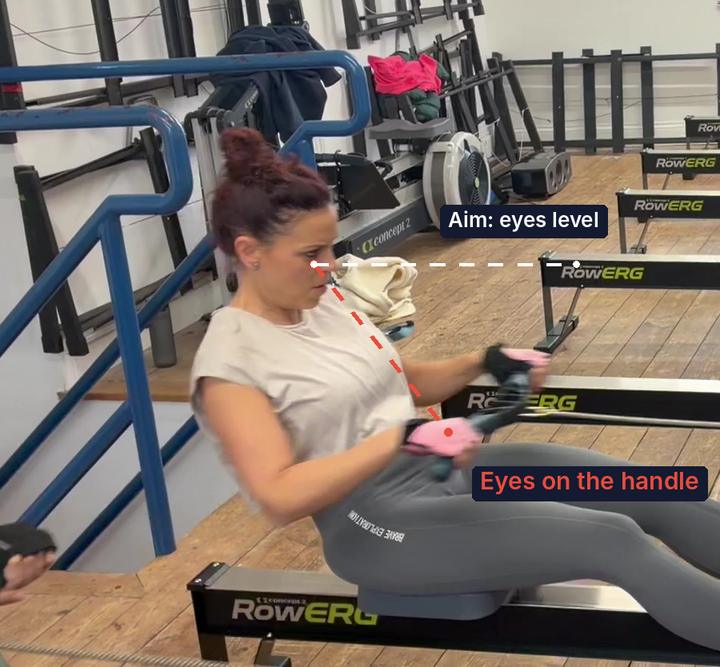
The head drops at the finish and the eyes go down towards the handle. Where the head goes, the shoulders and back follow.
At the finish (7.7 seconds): eyes down on the handle rather than level.
Cue“Eyes on the flywheel, chin level.”
Work on itPick a point straight ahead at eye level in every warm-up and keep your eyes on it.
Based on an 11-second clip, filmed from the front at an angle with other rowers sometimes in the way. For a fuller check: 30 seconds side-on at seat height, with the monitor showing split and rate.
Checking for Concept2 sessions…
Sunday 1 November 2026
Week 6 · Main aerobic piece
4 × 5 minutes, 2 minutes light paddle between
Purpose. Hold the same split on all four reps, at rate 20–22 and 6–7 out of 10. This is pacing practice for the retest.
Metres
Split /500m
Watts
Rate
Rep 1
866
2:53.2
67
21
Rep 2
898
2:47.0
75
22
Rep 3
897
2:47.2
75
22
Rep 4
887
2:49.1
72
22
Total
3,549
2:49.0
72
21
Did it meet the purpose?
Not quite — a slow first rep, then well paced
Rep 1 (2:53.2) was a cautious start, about 5 seconds per 500m slower than the other three. That one rep accounts for most of the 6-second spread.
After that the pacing was good: reps 2 and 3 were almost identical (2:47.0 and 2:47.2), and all of reps 2–4 were within 2.1 seconds.
Rep 4 eased back to 2:49.1 and power dropped from 75 to 72 watts — a small fade, not a big one.
The rate stayed at 21–22 throughout, inside the 20–22 range. Well controlled.
Next timeNext time, settle at about 2:48 from the first stroke of rep 1 — you showed in reps 2 and 3 that you can hold it. The target: all four reps within 2 seconds of each other.
Sunday 1 November 2026
Week 6 · Controlled interval progression
4 × 2 minutes on, 2 minutes light paddle between
Purpose. Firm to strong at rate 26–28, about 7 out of 10 — controlled, not sprinting — and keep the technique together as fatigue builds.
Metres
Split /500m
Watts
Rate
Rep 1
376
2:39.5
86
26
Rep 2
373
2:40.8
84
25
Rep 3
368
2:43.0
81
25
Rep 4
377
2:39.1
87
26
Total
1,495
2:40.5
85
25
Did it meet the purpose?
Not quite — well controlled, but the rate was a touch low
The rate was 25–26, just under the 26–28 target: reps 2 and 3 were at 25. Rate is the first thing to get right in this session.
The pace was fairly steady — 3.9 seconds between fastest and slowest. It slipped through rep 3 (2:43.0, 81 watts), then came back strongly on rep 4 (2:39.1, 87 watts): a good finish, not a sprint.
The average of 2:40.5 was about 8.5 seconds per 500m quicker than the 4 × 5 minutes. This piece is meant to feel clearly firmer than the steady work, so there is room to press a little harder.
Next timeNext time, hold rate 26–27 on every rep and press a little firmer. Aim for about 2:38 and keep rep 3 from slipping — you showed on rep 4 that the speed is there.
My course
How Nayansi has developed
Week 32,000m baseline
Week 6First video (provisional)
Week 8Technique baseline video
Week 10Mid-course video
Week 13Final video and 2,000m test
2,000m
Week 3—
→
Week 13—
Week 3 time to be added. The Week 13 test completes this.
Fitness — the key sessions
Going faster, or making more watts, at the same rate is the clearest sign of getting fitter. More metres per stroke at the same rate shows a more effective stroke.
Session
Type
Split
Watts
Rate
m/stroke
Wk 6 · 4 × 5 min
Steady
2:49.0
72
21
—
Wk 6 · 4 × 2 min
Firm
2:40.5
85
25
—
A trend chart appears once there is a second steady session at rate 20–22 to compare against — next is Week 8’s 2 × 12 minutes.
Technique scorecard
Week 6
Week 8
Week 10
Week 13
Stroke order: legs, body, arms
Secure
·
·
·
Body over before the slide
Secure
·
·
·
Tall back at the catch
Secure
·
·
·
Lean back at the finish
Secure
·
·
·
Hands, elbows and head at the finish
Getting there
·
·
·
Rhythm: quick drive, slow slide
Secure
·
·
·
Key: SecureGetting thereWorking on it · = to come. Week 6 scores are provisional, taken from a short clip filmed at an angle. The Week 8, 10 and 13 clips are filmed the same way each time — side-on, rate 20 — so they can be compared fairly.
Coach’s comment
To be added at the end of the course.
From a short video filmed from the front during a session, about five strokes at around rate 25. A powerful, quick drive led by the legs. The main thing to work on is the front of the stroke — you arrive at the catch and wait there, rather than going straight into the next drive.
Doing well
A powerful, quick driveThe drive is fast and clearly comes from the legs, with the arms staying straight until the legs are nearly down.
Level and squareFrom the front the handle comes in level and both hands match — no twisting or one side pulling harder.
Head upEyes forward and chin level through the whole stroke.
To work on
1
Don’t wait at the catch
You arrive at full compression and sit there for over half a second before the drive starts. The flywheel slows while you wait, so the next drive has to start from less speed. The slow part of the recovery should be the slide, with the change of direction at the front immediate.
Cue“Arrive and go.”
Work on itRatio rowing — a slow, controlled slide, then straight into the push the moment your shins reach vertical.
2
Sit tall at the catch
At the front the back rounds and the shoulders hunch forward. A tall, braced back connects the legs to the handle better and protects the lower back.
Cue“Chest up, shoulders down, reach from the hips.”
Work on itSlide build — arms only, then body and arms, then half slide, then full slide — keeping the back tall at every stage.
3
Keep the elbows in at the finish
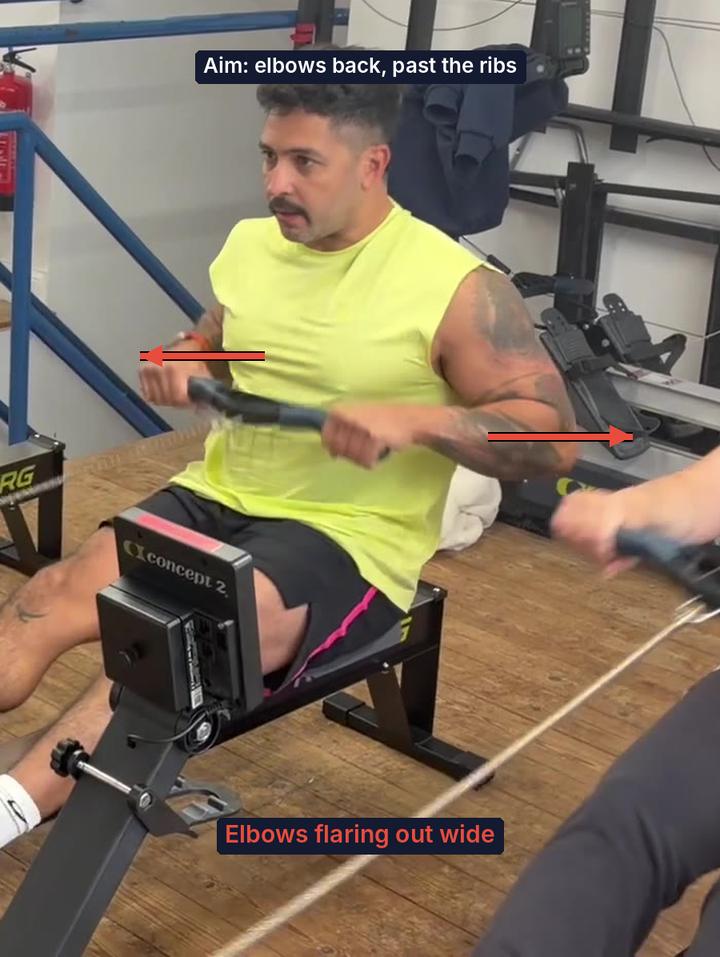
As the handle comes in, the elbows flare out wide to the sides rather than drawing back past the body. That shifts work from the big back muscles to the shoulders.
At the finish (4.2 seconds): both elbows out to the sides rather than drawn back past the body.
Cue“Elbows past the ribs.”
Work on itArms-only strokes with the legs flat and the body still, keeping the elbows close to the body.
Based on a 14-second clip filmed from the front, which shows the catch, the hands and the elbows well but not how far you lean back. For a fuller check: 30 seconds side-on at seat height, with the monitor showing split and rate.
Checking for Concept2 sessions…
My course
How Javier has developed
Week 32,000m baseline
Week 6First video (provisional)
Week 8Technique baseline video
Week 10Mid-course video
Week 13Final video and 2,000m test
2,000m
Week 3—
→
Week 13—
Week 3 time to be added. The Week 13 test completes this.
Fitness — the key sessions
Going faster, or making more watts, at the same rate is the clearest sign of getting fitter. More metres per stroke at the same rate shows a more effective stroke.
No session figures yet. Send your Logbook figures for the key sessions — Week 8 (2 × 12 min), Week 10 (30 min) and the Week 13 test — and they will appear here.
Technique scorecard
Week 6
Week 8
Week 10
Week 13
Stroke order: legs, body, arms
Secure
·
·
·
Body over before the slide
Not visible
·
·
·
Tall back at the catch
Working on it
·
·
·
Lean back at the finish
Not visible
·
·
·
Hands, elbows and head at the finish
Working on it
·
·
·
Rhythm: quick drive, slow slide
Working on it
·
·
·
Key: SecureGetting thereWorking on it · = to come. Week 6 scores are provisional, taken from a short clip filmed at an angle. The Week 8, 10 and 13 clips are filmed the same way each time — side-on, rate 20 — so they can be compared fairly.
Coach’s comment
To be added at the end of the course.
From a short video filmed from behind during a session, about three strokes at around rate 22. A well-ordered stroke with a good rhythm. The main things to work on are the two ends of it: getting the body forward before the catch, and not going so far back at the finish.
Doing well
Legs, body, arms — in that orderThe arms stay straight while the legs push, the body swings back as the legs flatten, and only then do the arms draw in.
A good ratioAbout 0.9 seconds on the drive and 1.5–1.8 on the recovery — close to the 1:2 the programme asks for.
A tidy drawAt the finish the handle comes in to the body with the elbows drawn back past the ribs, not flared out.
To work on
1
Swing the body forward before the slide
On the recovery the knees start to rise while the body is still upright, so you arrive at the catch sitting up straight with little forward lean. Angling the body forward from the hips first gives a longer, stronger stroke.
Work on itPause drill, pausing at “body over” — arms long, body angled forward from the hips — before letting the seat move.
2
Lean back a little less at the finish
At the finish the body goes well past “11 o’clock”. That adds no power and makes point 1 harder, because there is further to come forward again before the slide.
Cue“Lean back just past upright, then stop.”
Work on itBody-and-arms-only strokes, legs flat, to find a lean back you can return from easily.
3
Keep the head level at the finish
As you lean back the chin tips up and the head goes back with the body. Keeping the head level keeps the neck relaxed and makes it easier to judge how far you have gone.
Cue“Eyes on the flywheel, chin level.”
Work on itPick a point straight ahead at eye level in every warm-up and keep your eyes on it through the finish.
Based on a 7-second clip filmed from behind at a distance, with other rowers in the foreground. For a fuller check: 30 seconds side-on at seat height, with the monitor showing split and rate.
Checking for Concept2 sessions…
Sunday 1 November 2026
Week 6 · Main aerobic piece
4 × 5 minutes, 2 minutes light paddle between
Purpose. Hold the same split on all four reps, at rate 20–22 and 6–7 out of 10. This is pacing practice for the retest.
Metres
Split /500m
Watts
Rate
Rep 1
970
2:34.6
95
22
Rep 2
977
2:33.5
97
22
Rep 3
962
2:35.9
92
22
Rep 4
958
2:36.5
91
22
Total
3,868
2:35.1
94
22
Strokes
438
Per stroke
8.8 m
Drag factor
125
Calories
207
Rests: 819 m in 8:00 of light paddling (about 4:53 /500m). Whole session: 4,687 m in 28:00.
Did it meet the purpose?
Close, but not quite — a slight fade over the last two reps
All four reps were within 3 seconds of each other, with an average of 2:35.1. That is a good effort for a first go at even pacing.
The pattern matters more than the spread: rep 2 was the fastest (2:33.5) and reps 3 and 4 were each slower than the one before. The second half averaged about 2 seconds per 500m slower than the first.
Power dropped from 97 to 91 watts (about 6%) while the rate stayed at 22, so the slowdown came from less pressure on each stroke, not from rating lower.
The rate was steady at 22 throughout (438 strokes in 20 minutes) — the top of the 20–22 range, and well controlled.
The rests were genuinely easy (about 4:53 /500m), so tiredness from the recovery paddles is not the reason for the fade.
Next timeNext time, aim for 2:35 on every rep. Hold rep 1 and 2 back by a second, and the last two should feel the same. The target: all four reps within 1 second of each other.
Sunday 1 November 2026
Week 6 · Controlled interval progression
4 × 2 minutes on, 2 minutes light paddle between
Purpose. Firm to strong at rate 26–28, about 7 out of 10 — controlled, not sprinting — and keep the technique together as fatigue builds.
Metres
Split /500m
Watts
Rate
Rep 1
438
2:16.9
136
27
Rep 2
450
2:13.3
148
27
Rep 3
447
2:14.2
145
27
Rep 4
460
2:10.4
158
27
Total
1,795
2:13.7
146
27
Strokes
215
Per stroke
8.3 m
Drag factor
125
Calories
107
Rests: 850 m in 8:00 of light paddling (about 4:42 /500m). Whole session: 2,645 m in 16:00.
Did it meet the purpose?
Mostly yes — well controlled, with a faster last rep
The rate was exactly 27 on every rep, right in the middle of the 26–28 target. That is the most important part of “controlled”, and it was spot on.
Reps 2 and 3 were almost identical (2:13.3 and 2:14.2). Rep 1 was a cautious start (2:16.9), and rep 4 was the fastest by nearly 4 seconds (2:10.4, 158 watts).
Getting faster through a set is the right way round — the opposite of the fade in the 4 × 5 minutes. But a jump of almost 4 seconds on the last rep is edging towards a sprint, which this session asks you to avoid.
The average of 2:13.7 was about 21 seconds per 500m quicker than the 4 × 5 minutes — a clear, sensible step up from half pressure to firm.
Next timeNext time, start rep 1 at the pace of reps 2 and 3 (about 2:14) and hold it. If there is something left for the last rep, finish within a second or two of the others rather than four.
Week 7 · mid-week, on your own
Week 7 mid-week · Steady row
20 minutes continuous, splits every 4 minutes
Purpose. Rate 20, 5–6 out of 10 — you should be able to talk in short sentences. Your average split becomes your steady pace for the weeks ahead.
Metres
Split /500m
Watts
Rate
0–4 min
788
2:32.2
99
21
4–8 min
832
2:24.2
117
21
8–12 min
804
2:29.2
105
21
12–16 min
804
2:29.2
105
21
16–20 min
812
2:27.7
108
21
Total
4,040
2:28.5
107
21
Calories
225
Did it meet the purpose?
Not quite steady — an early surge, then very even
The rate was 21 throughout — one above the target of 20, but rock steady. Well controlled.
The second split (2:24.2, 117 watts) was a surge, about 5 seconds per 500m quicker than the rest. After that the last three splits were within 1.5 seconds of each other — that is the steady rowing this session is after.
At 2:28.5 this was about 6.6 seconds per 500m quicker than Sunday’s 4 × 5 minutes (2:35.1 at rate 22), even though the mid-week row is meant to be the easier of the two. Good for fitness — but check it really felt like 5–6 out of 10.
Next timeNext time, settle from the first stroke at the pace of your last three splits (about 2:29) and hold it, at rate 20. If you could not hold a short conversation, ease off a second or two — mid-week should leave you fresh for Sunday’s 3 × 8 minutes.
My course
How Gavin has developed
Week 32,000m baseline
Week 6First video (provisional)
Week 8Technique baseline video
Week 10Mid-course video
Week 13Final video and 2,000m test
2,000m
Week 3—
→
Week 13—
Week 3 time to be added. The Week 13 test completes this.
Fitness — the key sessions
Going faster, or making more watts, at the same rate is the clearest sign of getting fitter. More metres per stroke at the same rate shows a more effective stroke.
Session
Type
Split
Watts
Rate
m/stroke
Wk 6 · 4 × 5 min
Steady
2:35.1
94
22
8.8 m
Wk 6 · 4 × 2 min
Firm
2:13.7
146
27
8.3 m
Wk 7 mid-week · 20 min continuous
Steady
2:28.5
107
21
—
Steady pace over time — higher on the chart is faster.
Compare like with like: the trend means most when the rate and the effort are the same.
Technique scorecard
Week 6
Week 8
Week 10
Week 13
Stroke order: legs, body, arms
Secure
·
·
·
Body over before the slide
Working on it
·
·
·
Tall back at the catch
Not visible
·
·
·
Lean back at the finish
Working on it
·
·
·
Hands, elbows and head at the finish
Getting there
·
·
·
Rhythm: quick drive, slow slide
Secure
·
·
·
Key: SecureGetting thereWorking on it · = to come. Week 6 scores are provisional, taken from a short clip filmed at an angle. The Week 8, 10 and 13 clips are filmed the same way each time — side-on, rate 20 — so they can be compared fairly.
Coach’s comment
To be added at the end of the course.
Reference
Working out your pace
Two numbers on the monitor matter. Rate is strokes per minute, usually somewhere between 18 and 30 — the sessions tell you which rate to hold. Split is how long it takes you to row 500m at your current effort, and everything else follows from it. A split of 2:00 means every 500m takes two minutes, so 2000m takes eight.
Rate and split are not the same thing. You can raise the rate and row no faster at all, which is the commonest mistake on an ergo — the aim is a longer, stronger stroke rather than a hurried one.
500m split
2000m time
Change either box and the other follows.
500m
2:00
1000m
4:00
2000m
8:00
5000m
20:00
In 30 minutes you would row
7,500m
Put your Week 3 baseline into the 2000m box and it will tell you the split you held. Splits get quicker as you get fitter, so treat any number here as today's pace rather than a fixed ability. Rowing 2000m at 2:30 is a perfectly respectable place to start.
How hard should I row?
Light, half and firm
Pressure is the word rowers use for how hard you are pulling, and every block in the plan is colour-coded by it. You will hear the same calls from a coach in a boat. Judge them by how you feel and how easily you can talk, not by the numbers on the monitor.
Light rate 16–22
Should feel comfortable
You can hold a conversation
Warm-ups, drills, recoveries, cool downs
Half rate 20–24
Working, heart rate up
You can speak in short sentences
The steady aerobic pieces — most of the course
Firm rate 24–29
Working hard, breathing hard
Intervals, race pace and the 2,000m
Short efforts, with recovery between
You will also hear three-quarter pressure, which sits between half and firm. The sessions use a 1 to 10 effort scale alongside the pressure calls: 4–6 is light to half, 6–7 is firm but sustainable, and 8–9 is race effort.
Sunday sessions
Thirteen weeks
One coached session a week, built from blocks with a water break between them. The bar under each week shows the shape of the session — green is light pressure, amber half, red firm. Tap the circle to mark a week done. From Week 7 there is also a mid-week session to do on your own.
Weeks 1–3Foundation
Learning the stroke, and setting the baseline you will be measured against.
WEEK1
New session — for review
Aim. Get comfortable on the machine and learn the stroke. Nothing today is a fitness test — the whole session is about position, sequence and rhythm.
Effort guideEverything light. You should be able to hold a conversation throughout.
10′
15′
15′
5′
On the ergo ≈ 45 min4 blocks
Setting up
10 min
How the machine works and how to sit on it.
Damper at four or below; the monitor at eye level
Foot straps across the ball of the foot
Holding the handle — hooked fingers, loose thumbs, relaxed shoulders
Learning the stroke
15 min
Built up in stages, stopping at each one.
Arms only → body and arms → half slide → full slide
Legs stay down until the handle has passed the knees
Legs, body, arms on the drive; arms, body, legs on the recovery
First pieces
15 min
3 × 3 minutes at light pressure, rate 18–20, with 2 minutes’ rest between each. Stop if the technique goes.
Long strokes rather than quick ones
Consistent rhythm matters more than the split today
Warm down
5 min
Easy rowing, then stretching in the gym.
WEEK2
Aim. Build on the first session: short controlled pieces, with drills between them to keep the stroke honest.
Recap of last week. Basic technical points — getting the basics right.
Arms only → body and arms → half slide → full slide. Legs stay down until the handle passes the knees.
Work
8 min
2 minutes at half pressure, rating 18–22, then 2 minutes’ rest. Twice through — 8 minutes in total.
Legs-only drill
3 min
Row using the legs alone, arms straight throughout. This teaches you that the power comes mainly from the legs, and stops the early arm pull.
Work
13 min
5 minutes at half pressure, rating 18–22, then 3 minutes’ rest. Twice through — 13 minutes in total.
Focus on holding technique under a little more pressure
Pause drill
3 min
Add a 2-second pause at the finish, or at “arms away”. Improves rhythm, stops the recovery being rushed, and reinforces a quick drive with a controlled return.
Warm down
5 min
Easy rowing, then stretching in the gym.
WEEK3
Aim. Row a 2,000 metre piece and record the time. This is your baseline, and the number every other week is working against.
Recap of last week. Basic technical points — getting the basics right.
Effort guideWarm-up light and half pressure. The 2,000m is controlled, not maximal — pace it.
5′
3′
8′
11′
3′
5′
On the ergo ≈ 37 min7 blocks
Warm up on the ergo
5 min
Five minutes easy.
Slide build
3 min
Arms only → body and arms → half slide → full slide. Legs stay down until the handle passes the knees.
Work
8 min
2 minutes at half pressure, rating 18–22, then 2 minutes’ rest. Then 2 minutes at three-quarter pressure, rating 22–24, then 2 minutes’ rest.
Pause drill
2 min
A 2-second pause at the finish or at “arms away”.
The 2,000m baseline
11 min
2,000 metres, for a time you can compare against at the end of the course. Row it at a controlled rate of 20–24, and pace yourself — it may take anywhere between 8 and 12 minutes. Lift the rate over the last 250m if you want to.
Write the time down. You will need it in Week 13
The Pace section on this page will turn it into a 500m split
Legs-only drill
3 min
Legs alone, arms straight throughout.
Warm down
5 min
Easy rowing, then stretching in the gym.
Weeks 4–7Building the base
Aerobic work, controlled intervals, and technique that holds together when you are tired.
WEEK4
Aim. Start building an aerobic base, introduce controlled intensity, and reinforce technique under fatigue.
Recap of last week. Basic technical points — getting the basics right.
Effort guideMostly 4–6 out of 10, with one short harder block.
8′
15′
8′
5′
On the ergo ≈ 38 min5 blocks
Warm-up and technique
8 min
Eight minutes continuous.
0–3 min — light, rate 18
3–6 min — steady half pressure, rate 20
6–8 min — include 3 × 10 strokes firm, with slightly stronger legs
Pause drill
2 min
A 2-second pause at the finish or at “arms away”. Improves rhythm and stops the recovery being rushed.
Main aerobic piece
15 min
3 × 4 minutes, with 1 minute light paddle between each.
Rate 20–22
Three-quarter pressure — comfortable but working
Focus: long strokes, consistent rhythm
Interval piece
8 min
4 × 1 minute on, 1 minute off. This introduces speed but keeps it controlled.
On — slightly faster than 2k pace, about 7 out of 10, rate 24
Off — very light paddle, rate 18
Cool down
5 min
Easy row at rate 18, very light, gradually reducing the pressure. Then stretching in the gym.
WEEK5
Aim. Extend aerobic capacity, improve pacing awareness, and hold strong technique over longer efforts. A step up from last week's 3 × 4 minutes.
Recap of last week. Basic technical points — getting the basics right.
Effort guideMostly 4–6 out of 10 — half to firm pressure, with firm controlled pushes. No maximal work.
10′
20′
10′
5′
On the ergo ≈ 48 min5 blocks
Warm-up and technique
10 min
Ten minutes continuous, building through the gears.
0–3 min — light, rate 18
3–6 min — steady, rate 20, half pressure
6–8 min — firm, rate 22–24, building leg drive
8–10 min — include 3 × 10 strokes strong; not sprinting, just a sharper connection
Ratio rowing
3 min
Think about the 1:2 timing — quick drive, controlled recovery. This reinforces what the pause drill introduced last week.
Main aerobic piece
20 min
2 – 4 – 6 – 4 – 2 minutes, with 1 minute light paddle between each.
Rate 20–22
5–6 out of 10 — steady and sustainable
Focus: consistent split across each block, relaxed upper body, strong leg drive without rushing
Controlled interval progression
10 min
5 × 1 minute on, 1 minute off, building on last week’s intervals.
On — rate 24–26 at firm pressure, slightly quicker than aerobic pace but controlled
Off — very light paddle, rate 18
Focus: keep the technique identical to your steady rowing, with smooth acceleration at the catch
Technique under fatigue
5 min
Short continuous row at rate 20, light to half pressure. Insert 10 strokes of perfect technique every minute.
WEEK6
Aim. Continue building aerobic endurance and start sharpening pacing judgement. Last week's steady work extends into longer blocks, and the intervals go a little further under control.
Recap of last week. Controlled interval progression, and keeping technique together as fatigue builds.
Effort guideMostly 5–7 out of 10, with one firmer block. No maximal work — we are still building.
10′
26′
14′
5′
On the ergo ≈ 58 min5 blocks
Warm-up and technique
10 min
Ten minutes continuous, building through the gears.
0–3 min — light, rate 18
3–6 min — steady, rate 20, half pressure
6–8 min — firm, rate 22–24, building leg drive
8–10 min — include 3 × 10 strokes strong; not sprinting, just a sharper connection
Ratio rowing
3 min
Keep working the 1:2 timing — quick drive, unrushed recovery. Aim for a smoother, more automatic feel than last week.
Main aerobic piece
26 min
4 × 5 minutes, with 2 minutes light paddle between each.
Rate 20–22
6–7 out of 10 — firm but sustainable
Aim for the same split on all four reps; this is pacing practice for the retest
Build to firm in the last 30 strokes of each rep, not from the start
Controlled interval progression
14 min
4 × 2 minutes on, 2 minutes off — longer sustained pushes than last week’s single minutes.
On — rate 26–28, firm to strong, about 7 out of 10; controlled, not sprinting
Off — very light paddle, rate 18
Focus: hold technique together as fatigue builds — smooth acceleration at the catch, no rushing the finish
Technique under fatigue
5 min
Short continuous row at rate 20, light to half pressure. Insert 10 strokes of perfect technique every minute.
WEEK7
Aim. Your longest continuous efforts yet — almost three times the length of the 2,000m itself — so that pacing discipline becomes automatic.
Recap of last week. Your longest continuous efforts yet, and holding pace under fatigue.
Effort guideMostly 5–7 out of 10, with one firmer block. Still no maximal work.
10′
26′
12′
5′
On the ergo ≈ 55 min5 blocks
Warm-up and technique
10 min
Ten minutes continuous, building through the gears.
0–3 min — light, rate 18
3–6 min — steady, rate 20, half pressure
6–8 min — firm, rate 22–24, building leg drive
8–10 min — include 3 × 10 strokes strong; not sprinting, just a sharper connection
Ratio rowing
2 min
A brief reminder of the 1:2 timing before the long pieces.
Main aerobic piece
26 min
2 × 12 minutes, with 2 minutes light paddle between them.
Rate 20–22
6–7 out of 10 — firm and sustainable
The second piece should be no slower than the first. If it is, you started too hard
Controlled interval progression
12 min
3 × 3 minutes on, 1 minute off — longer sustained pushes again.
On — rate 26–28, about 7 out of 10
Off — very light paddle, rate 18
Cool down
5 min
Easy row at rate 18, very light, gradually reducing the pressure. Then stretching in the gym.
WEEK9
New session — for review
Aim. Move from time to distance. Rowing a set distance teaches you what your split feels like from the inside, which is what the race-pace work depends on.
Recap of last week. Your longest steady blocks so far.
Effort guideAerobic work 6–7 out of 10, the short block 8. Full recovery between the 1,000s.
10′
24′
8′
5′
5′
On the ergo ≈ 52 min5 blocks
Warm-up and technique
10 min
Ten minutes continuous, building through the gears.
0–3 min — light, rate 18
3–6 min — steady, rate 20, half pressure
6–8 min — firm, rate 22–24, building leg drive
8–10 min — include 3 × 10 strokes strong; not sprinting, just a sharper connection
Distance pieces
24 min
4 × 1,000m, with 2 minutes light paddle between each.
Rate 22–24
7 out of 10 — working, but you should finish each one able to speak
Note the split for every rep. All four should be within a second or two
This is the first time you have rowed to a distance rather than a clock since Week 3
Short sharpener
8 min
4 × 1 minute on, 1 minute off, to put some speed back in the legs after the long pieces.
On — rate 28–30, 8 out of 10
Off — very light paddle, rate 18
Technique under fatigue
5 min
Short continuous row at rate 20, light to half pressure. Insert 10 strokes of perfect technique every minute.
Cool down
5 min
Easy row at rate 18, very light, gradually reducing the pressure. Then stretching in the gym.
WEEK10
New session — for review
Aim. The biggest aerobic session of the course — one long continuous row. Nothing hard, just long. This is the last piece of endurance work before the focus turns to race pace.
Recap of last week. Distance pieces, and holding one split across four reps.
Effort guide6 out of 10 throughout the long piece. It should feel dull rather than difficult.
10′
30′
5′
On the ergo ≈ 48 min4 blocks
Warm-up and technique
10 min
Ten minutes continuous, building through the gears.
0–3 min — light, rate 18
3–6 min — steady, rate 20, half pressure
6–8 min — firm, rate 22–24, building leg drive
8–10 min — include 3 × 10 strokes strong; not sprinting, just a sharper connection
The long row
30 min
30 minutes continuous, without stopping.
Rate 20–22 throughout
6 out of 10 — half to three-quarter pressure
Hold one split from start to finish; do not chase it if it drifts
If the technique goes, drop the pressure rather than stopping
Legs-only drill
3 min
Legs alone, arms straight, to unwind the body after the long piece.
Cool down
5 min
Easy row at rate 18, very light, gradually reducing the pressure. Then stretching in the gym.
Weeks 11–13Sharpen, taper, test
Race pace rehearsed, then volume cut right back, then the retest.
WEEK11
Aim. The peak quality week. We shift from aerobic volume to race-pace specifics — rehearsing the exact rate and effort you plan to hold for the whole 2,000m in Week 13. Expect full recovery between the reps; this is about quality, not grinding out volume.
Recap of last week. Your longest sustained pieces yet, and holding pace under fatigue.
Effort guideWarm-up and top-up stay easy at 4–6 out of 10. The two race-pace pieces are 8–9 — your goal 2,000m effort — with full recovery between them.
10′
16′
10′
5′
On the ergo ≈ 41 min4 blocks
Warm-up and technique
10 min
Ten minutes continuous, building through the gears.
0–3 min — light, rate 18
3–6 min — steady, rate 20, half pressure
6–8 min — firm, rate 22–24, building leg drive
8–10 min — include 3 × 10 strokes strong; not sprinting, just a sharper connection
Race-pace pieces
16 min
2 × 1,000m at your goal 2,000m race pace, with a full 4-minute light paddle recovery between them.
Rate 24–26
8–9 out of 10 — this should feel like race effort, not a sprint
Lock in the exact rate and effort you plan to hold in Week 13, and note your split after each rep so you have a concrete target
Both reps should feel roughly the same. If the second is much slower, you went off too hard
Aerobic top-up
10 min
Continuous easy row — active recovery, not additional training stress.
Rate 20, half pressure, 4–5 out of 10
Smooth, relaxed technique; let the legs recover while staying loose
Cool down
5 min
Easy row at rate 18, very light, gradually reducing the pressure. Then stretching in the gym.
WEEK12
Aim. Taper week. Volume drops right down and recovery goes up — the goal is to arrive at the 2,000m fresh, not fatigued. What work we do is short, sharp, and slightly faster than goal race pace, to keep the legs feeling quick without digging into fatigue.
Recap of last week. Locking in your race-pace rate and effort for the 2,000m.
Effort guideShort bursts at 8–9 out of 10, a touch faster than target 2,000m pace, with full recovery between every rep. Nothing today should leave you feeling drained.
8′
27′
8′
On the ergo ≈ 43 min3 blocks
Warm-up and technique
8 min
Eight minutes continuous — shorter than usual, since there is no need to build fatigue this week.
0–3 min — light, rate 18
3–6 min — steady, rate 20, half pressure
6–8 min — include 3 × 10 strokes strong, sharp and light
Speed sharpeners
27 min
6 × 500m at slightly faster than your goal 2,000m pace, with a full 3-minute light paddle recovery between reps.
Rate 26–28
8–9 out of 10 — crisp and quick, not a grind
Sharp catches and a light, quick recovery; this is about feel and speed, not fatigue
Full recovery every time. If you are still breathing hard when the next one starts, take longer
Cool down
8 min
Very easy row at 16–18 strokes per minute, gradually reducing the pressure to almost nothing. Then stretching in the gym.
NoteFor the week ahead: prioritise sleep and hydration, and keep any extra training light. You want to walk into the 2,000m feeling fresh, not tired.
WEEK13
Aim. Retest the 2,000m from Week 3 and see what thirteen weeks of training has done. Warm up thoroughly, then go for it.
Recap of last week. A light, sharp taper to arrive fresh for today.
Effort guideThe warm-up stays light. The 2,000m is a genuine test effort — pace it using the split you locked in during Week 11.
10′
10′
8′
On the ergo ≈ 30 min4 blocks
Warm-up
10 min
Progressive slide build — arms only → body and arms → half slide → full slide, legs down until the handle passes the knees.
2 minutes at half pressure, rating 18–22
2 minutes at three-quarter pressure, rating 22–24
3 × 10 strokes strong, building the rate to 26–28, to open the legs without creating fatigue
Pause drill
2 min
A 2-second pause at the finish or at “arms away”. A reminder of rhythm, not a fitness session.
The 2,000m test
10 min
2,000 metres. Compare the result directly against your Week 3 baseline.
Hold the split you established in Week 11 for the first 1,500m
Settle at 24–26 strokes per minute for the body of the piece
Over the last 250–500m, lift the rate and empty the tank — this is the one place in the whole course to go hard
Note your time and split. This is the number the last twelve weeks have been building toward
Cool down
8 min
Legs-only drill — rowing with the legs alone, arms straight throughout. A gentle reminder that the power comes mainly from the legs, and a good way to unwind after a hard effort. Very light pressure, rate 16–18. Then warm down and stretching in the gym.
NoteWhatever the number says today, nine weeks ago you were rowing 3 × 4 minutes at three-quarter pressure. Take a moment to notice how far the aerobic base, the pacing and the technique have come.
On your own
Mid-week sessions
One extra 40-minute session between Sundays, from Week 7 to the test. Sunday is where the firm work and the coached technique happen; mid-week is the steady aerobic rowing, rate control and pace practice that make Sunday’s pieces feel easier. Each one leads into the Sunday session with the same number. Tap the circle to mark it done, or print any session to take to the gym.
Any day from Tuesday to ThursdayKeep at least two clear days before Sunday’s session — three before the Week 13 test.
Set the monitor for 40 minutesOn the PM5: Select Workout → New Workout → Single Time → 40:00. Damper at 3–5, as on Sundays. The clock then tells you which block you are in.
Stretch before and afterFive minutes either side. There is no coach to remind you, so build it into the 40.
Record itPair ErgData with the monitor before you start so the session saves to your Concept2 Logbook.
Nothing hard on your ownMid-week stays at 7 out of 10 or below. If anything hurts or feels wrong, stop, and mention it to a coach on Sunday.
Weeks 7–13Between Sundays
Steady volume first, then pace, then a gentle taper into the test.
WEEK7
Mid-week · on your own
Aim. Steady aerobic volume and rate control. Sunday’s pieces get longer this week — this session banks the easy miles that make them possible.
How it fits. Before Sunday’s Week 7: 3 × 8 minutes and firm 2-minute intervals. Nothing firm today, so you arrive fresh for them. Sunday’s session →
Effort guide5–6 out of 10 throughout. You should be able to talk in short sentences.
A 2-second pause at “arms away” on every stroke, then on every third stroke for the last minute. Settles the sequence before the steady work.
Steady pieces
21 min
2 × 10 minutes, with 1 minute light paddle between them.
Rate 20
5–6 out of 10
Hold the steady split you noted last week, to within a second or two
Legs-only drill
3 min
Legs alone, arms straight — a reminder that the power comes mainly from the legs.
Cool down
5 min
Easy row at rate 18, gradually reducing the pressure. Then five minutes of stretching.
WEEK9
Mid-week · on your own
Aim. Learn to read the split. Sunday moves from time to distance, so today you practise holding one split on the monitor and correcting it without chasing it.
How it fits. Before Sunday’s Week 9: 4 × 1,000m and a short, sharp block. Sunday’s session →
Effort guide6 out of 10 for the long row. The low-rate strokes are strong but slow, so the heart rate stays down.
24 minutes continuous, thought of as three 8-minute thirds.
Rate 20–22
Pick a split 2–3 seconds quicker than your steady pace and hold it
Check the monitor once a minute; if you have drifted by more than two seconds, correct it over the next five strokes, not one
Note the split for each third — all three should match
Low-rate power
4 min
4 × 30 seconds at rate 18 with a strong leg drive, 30 seconds easy between.
Long, powerful drive; slow, controlled recovery
Builds the leg connection Sunday’s 1,000s need, without pushing the heart rate up
Cool down
4 min
Easy row at rate 18, gradually reducing the pressure. Then five minutes of stretching.
WEEK10
Mid-week · on your own
Aim. Some changes of rhythm before Sunday’s long row. A pyramid of steady pushes keeps the aerobic work moving without leaving you tired for 30 minutes on Sunday.
How it fits. Before Sunday’s Week 10: one 30-minute continuous row. Sunday’s session →
Effort guide6–7 out of 10 on the pushes, easy between. Nothing firm.
20 minutes continuous, a notch easier than recent weeks.
Rate 20
4–5 out of 10 — you could hold a conversation
Long, smooth strokes; let the legs freshen up
Start practice
4 min
Three practice starts, with at least a minute of easy paddling between each.
5 quick, shorter strokes to get the flywheel spinning, then lengthen out to full slide
Settle to rate 26 within 10 strokes — the settle matters more than the start
Stop after 15 strokes; this is about the pattern, not the effort
Ratio rowing
3 min
Three minutes of 1:2 timing to bring the rhythm back down after the starts.
Cool down
5 min
Easy row at rate 18, gradually reducing the pressure. Then five minutes of stretching.
WEEK13
Mid-week · on your own
Aim. Stay loose, stay fresh. This is your last row before the test — nothing today should leave you tired.
How it fits. Before Sunday’s Week 13: the 2,000m test. Do this one early in the week, so you have at least three easy days before Sunday. Sunday’s session →
Effort guideAbout 4 out of 10 throughout, apart from two short spells of race rhythm at half pressure.
2 × 20 strokes at your race rate, half pressure, with at least a minute easy between.
Rate 24–26
Rhythm only — the split does not matter today
Picture Sunday’s plan: the split you locked in during Week 11, then lift over the last 250–500m
Pause drill
3 min
A 2-second pause at “arms away”. A final reminder of rhythm.
Cool down
5 min
Easy row at rate 18, gradually reducing the pressure. Then five minutes of stretching.
NoteFor the rest of the week: sleep, water and normal meals. No extra training before Sunday.
Check your session
Session report
Did you hit the purpose of the session? Pick the piece you rowed, paste in your figures, and get a report on your pacing and rate against the programme’s targets — whenever you like.
1 Get your figuresIn ErgData or your Concept2 Logbook, open the workout and copy the interval or split rows. Or just type them: one rep per line, split then rate, e.g. 2:34.6 22.
2 Pick the piece and pasteChoose the session below, paste your rows into the box, then tap Run my report.
Your figures stay on your phone — nothing is sent anywhere.
Your saved reports
Saved on this phone only.
For coaches
Concept2 connections
Coaches only — needs the coach code. Make a connect link for each rower and send it to them. Once they approve on Concept2, their sessions appear on their Workouts tab automatically.
The Concept2 Client Secret hasn’t been added in Netlify yet, so connections will fail until it is.
Group summary
Connections and links
The app can only read results — it can’t change anything in anyone’s Logbook. A rower can also remove access themselves on log.concept2.com under Edit Profile → Applications.